Talking Rubbish: a history of bottles – a talk by Richard Westacott-Jones

Richard started his talk by saying that he had been interested in bottle digs since the age of 2 years old; it certainly showed in his enthusiasm and vast knowledge of the subject. He mentioned how he had travelled the country from Torquay to Scotland, digging over various types of sites, including a mineral water one at Okehampton, Chagford sanitorium and Victorian St. Marychurch. These unearthed a vast collection of different items ranging from specialist areas such as poison and “onion” bottles (one dated 1699) to others originally of liquor, hot water, ointments, soda, ink and even lavatory pulls, pot lids, kettles and cream cylinders and of different materials such as glass, metal and china. An interesting observation was how the materials collected reflected big differences between the social and economic circumstances of the local populace (some digs unearthed caviar jars and smelling salts).
Some of these sites were very large and required specialist excavation equipment. Extensive landscaping is also required post excavation. Richard explained how he found the various locations through detailed research using the society networks, historical records, trade directories like Kelly’s, OS maps, specialist books and bottle forums (Devon & Cornwall Bottle Diggers). Also by attending bottle fairs, shows and competitions.
He then moved on to talk about how laws regarding the collecting and burial of rubbish had developed over the last 200 years or so and that most of his digs were of material post 1870. In the early 19th century night soil men were employed to empty cess pits but there were no official refuse collections or disposal methods. Many items were reused and people scavenged for items they could return for the deposits. Some rubbish went to farmers for fertiliser and a lot went “over the hedge” or buried in the garden. As the population grew, so did the refuse and filthy conditions, leading to declines in sanitation and public health with Cholera and TB becoming epidemics.
Despite Government laissez faire attitudes, in 1842 Edwin Chadwick recommended big changes such as sewers, official rubbish collection, local medical officers, boards of health and reservoirs. This led to the Public Health Act of 1848, though most of the required actions were voluntary. There was widespread opposition and by 1854, many of the changes were abolished and Chadwick pensioned off!
However with the return of cholera by 1866 a new Act was passed in 1875 with compulsory rubbish burial and responsibility for collection and disposal now with local councils. Scavengers were gone and public health gradually improved. Sites for burial were now sought after in the form of old quarries, mines and railway banks. Dock dung was collected from the street , loaded onto to barges and dumped in the river.
Richard supplemented his talk with nostalgic images from posters, advertisements and signs from the 19th century onwards, illustrating the choices made by people according to their social standing and conditions and what was contained in their rubbish. He also produced astonishing images of his vast and varied collection of items. Several members had questions answered in detail on items they had brought along. More of his collection can be seen at his stall in the Tavistock Pannier Market.
A Guided visit to Hurdwick Quarry with Chris Bellers
Our last outdoor event of the year saw over 30 members and guests congregate at the home of the former golf course, courtesy of the owner Martin Wood, having successfully negotiated some formidable speed bumps en-route! Chris Bellers led us down a leafy lane past banana trees to the old overgrown quarry, now with its amphitheatre and sit mats, (currently used as a wedding venue) and gave a talk on its history and the geology of the area.
Hurdwick stone was described in 1954 by eminent local historian W.G. Hoskins as a “loose textured , free working trappean ash, extensively quarried throughout medieval times up until the late C19. Durable, distinctly beautiful with a colour of underwater green and with a pitted appearance.” Chris passed around some samples. It is known that this type of stone comes from a thin line of Carboniferous rock, known as the Milton Abbot Formation, stretching from Tintagel to just beyond Tavistock, dating from c347 million years ago, making it older than the granite of Dartmoor.
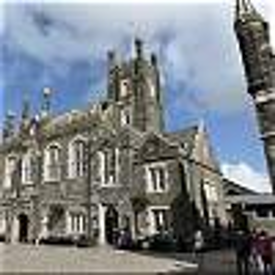
In 1185, the Abbot of Tavistock Abbey created the Borough of Tavistock and the rural part of the estate became known as the Manor of Hurdwick, centred on the farm. It was a substantial settlement supplying agricultural produce to the Abbey and holding manor courts and Hundred meetings. It is believed that the quarry supplied the stone for the building of the Abbey, though there is no real evidence for this, the earliest known date for the quarry in use being 1853. The stone was however used extensively by the Duke of Bedford for the rebuilding of the town centre , including the Town Hall, Ford Street alms-houses, the Pimple and Endsleigh House. The churches of St. Eustachius and St. Michael de Rupe at Brentor are also of Hurdwick stone. The quarry officially closed in 1920 but was reopened temporarily in 1988. It later supplied stone for restoration work on a castle in Scotland.
There were other quarries in the area producing the stone, the best known probably Buddle Quarry in Waddon Lane. It possibly opened after Hurdwick (given the name of the stone) and was within the Borough created by the Abbot. It also supplied stone for the rebuilding of the town centre and was perhaps preferred as being closer to the town, even though this may have been of different quality. The site is currently protected from development under the Devon County Mineral Plan.
The 1905 OS map shows three possible quarries across the Tavy opposite the Abbey remains though somewhat obscured by the old railway line, two of them marked “Old Quarry” and “Deer Park Quarry”. There are other sites that could have supplied Hurdwick stone particularly near the farm which has the name quarry mentioned in field names. Closer to the town there is evidence of further workings in Wyatt Lane, Glanville Road and Bannawell Street.
The name Hurdwick stone seems to have been adopted in the C19 because of the quarry on the farm of that name. Once the rebuilding of Tavistock gathered pace, the stone may then have come from the nearer and more recently opened Buddle Quarry. The distinctiveness of this stone is still very much part of the town’s heritage.
The Hidden History of St. John’s Well with Sharon Gedye
This walk explored the largely forgotten landscape of St John’s, a place that has almost disappeared from modern Tavistock despite its fascinating medieval and post-medieval history. Today, little survives beyond the name of St John’s Well, yet historical maps, archival records, eyewitness accounts and local histories reveal a site that once played an important role in the religious, social and medical life of the town.
The circular walk from the Wharf to Abbey Bridge and then back on the wooded St John’s side of the Tavy reconstructed a lost riverside landscape. Across the River Tavy from the Abbey Still House once stood St John’s Chapel, a hermitage with a holy well. Although all visible traces had disappeared by the early nineteenth century, writers including Anna Eliza Bray, Alfred John Kempe and Rachel Evans described the location, recalling a clear spring, wooded hillside and striking rock formation overlooking the river. Their accounts preserve the memory of a place that was dramatically altered by the arrival of the railway in 1859, when engineering works destroyed much of the original landscape.
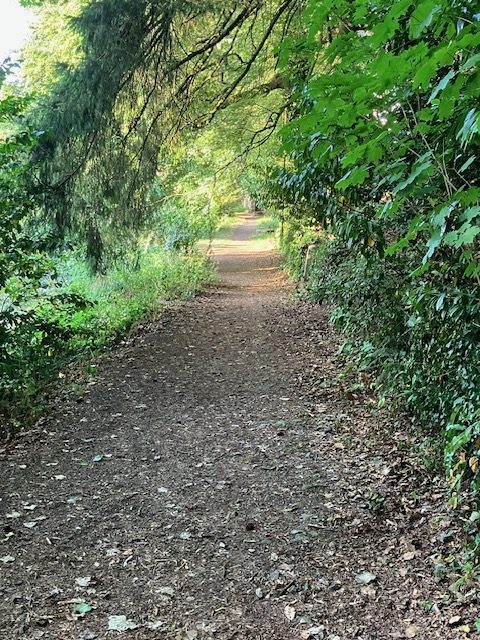
The walk also highlighted how Tavistock’s medieval road network differed from that seen today. Before the construction of the present Abbey Bridge, travellers approached the town via the Great Bridge, following a road that descended to the river at the ‘Crocky Nine Steps’. These are the crooked old steps that can still be seen joining St John’s Walk to the riverside footpath. Whilst the modern road bypasses St John’s, the old route passed directly by St John’s, suggesting that the chapel and hermitage occupied a prominent position for traders, pilgrims and other travellers rather than the secluded peripheral location it appears to occupy today.
The earliest documentary evidence traces St John’s Chapel back to 1383, when a licence was granted for divine service to a poor hermit. Later records describe the chapel beside the River Tavy and refer to gifts from “John the Hermit” including a silver cross containing a fragment of the ‘true cross’, a relic which would have attracted pilgrims. The site appears to have served not only as a place of worship but also, at least for a time, as a hospital or lazar house caring for those suffering from infectious diseases. During the plague outbreaks of the seventeenth century, the former chapel was reused as a pest house, reflecting its continued role in public health on the edge of the town.
The story of St John’s also illuminates wider aspects of medieval life. Hermits were not simply isolated religious figures but often provided hospitality, maintained bridges and roads, cared for the sick and supported travellers. The combination of a roadside location, holy well and possible relic suggests that St John’s belonged to this tradition of “town hermits”, serving both spiritual and practical needs.
One of the most intriguing discoveries is the appearance of a ‘summer house’ annotation on an eighteenth-century plan of the site. Rather than a garden building, this may refer to a structure associated with the medieval ‘summer game’—the lively midsummer celebrations held on the Eve of St John the Baptist. Historical evidence of St John’s Eve traditions from across Europe indicates that the people of Tavistock may have celebrated this festival with bonfires, dancing, processions, feasting and drinking. Irrespective of the function of the ‘summer house’, water-related locations (such as holy wells) and patronal saint locations were typically the focus of festivities providing a double reason why St John’s Eve would have been celebrated at this riverside location in medieval Tavistock.

The walk concluded at the present St John’s Well – a ‘spring’ framed by an arch with a plaque announcing its name. Traditionally St John’s Well was believed to possess healing properties, particularly for skin ailments (perhaps a tradition linked to the belief that St Johns had a leper hospital). However, this well is not all it appears. Two letters to the Tavistock Gazette in 1908/1909 suggest that the original spring gushed from the ground (rather than trickled from a rock) near ‘Crocky Nine Steps’, opposite the Still House. One letter writer confirms that the holy well was finally destroyed during railway construction. The other makes a plea for St John’s Well to be brought back. The St John’s Well we see today, it would appear, is therefore an Edwardian memorial to the lost medieval spring – a touching reminder of the once-important St John’s landscape and how it has been transformed.
A visit to Burrator House and Gardens, Sheepstor Church and Tombs with Jason Brooke

Jason was host to 40 members and friends for our June event on a very interesting and informative evening. Starting at the house, he talked through the family history of the three Rajahs, staring with the original James Brooke, born in Bengal in 1801 to Thomas who was a judge in the East India Co. After his father’s death he travelled extensively in the Far East arriving in Sarawak, a war-torn country ravaged by pirates. After helping the local administrators, he was appointed their Rajah in 1841 and proceeded to suppress piracy, slavery and head hunting, creating a British Code of Justice. With his nephew John, they succeeded in bringing peace and prosperity to Sarawak, which was then recognised as an independent State by Great Britain (GB) in 1864.
Charles Anthoni became the second Rajah after James retired in 1863 and continued the great work , continuously travelling the vast country, meeting with the local tribes, gaining their trust and establishing medical services, schools and Christian missions, whilst trade and agriculture prospered. He died in 1917 after being Rajah for almost fifty years and was succeeded by his eldest son, Charles Vyner Brooke. However, the country suffered great devastation in WW2 and feeling unable to provide the resources necessary for restoration, he ceded it to GB as part of the Federation of Malaysia. Sarawak was granted self-government in 1963.
James, the first Rajah bought Burrator House in 1859 and retired there in 1863, dying there in 1868. The house was then bought by the Maristow Estate and leased out with various extensions and alterations carried out. It was sold again in 1970 and was a hotel during the 1990’s with thoughts of turning it into a museum. Jason and family purchased it in 2019.
His talk was followed by a ramble around the extensive gardens, currently being restored, with their large trees, mossy boulders and bridges over the cascading brook running into the old gravel pit, now a beautiful lake (apparently covered in ice on New Years Day). Jason has also planted a traditional orchard and is restoring an old stone-faced bank. 36 acres of the land is home to a herd of cows and some sheep.
A short stroll down the road took us to the church of St. Leonard and the impressive tombs of the Rajahs, some built of Dartmoor granite and carved on site. James’ is the most imposing being of pink Aberdeen granite, but the others stand out too as impressive memorials of the family dynasty.
The church itself is of the 15th century having had several major restorations and repairs since. The pews replaced in oak in the 1920’s have bench ends carved by the famous Pinwill sisters. A memorial window in the South Wall was given by the Association of Sarawak Civil Servants with the Brooke coat of arms at the top. On the wall there is also an Iban textile made by the local people of Borneo and various plaques re the Brooke family, plus an excellent leaflet about the 3 Rajahs.
An excellent evening led by 6th generation Jason Brooke who has set up his own trust to preserve the collection of artefacts and papers related to the Brooke family and its century long dynasty in Sarawak.
Devon’s Waterwog and the History of the Golly 1895-2026 – a talk by Dr. Todd Gray
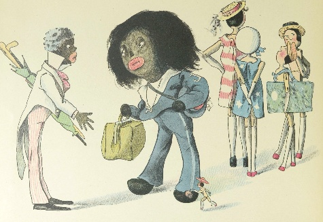
Todd’s latest talk followed his trend of tackling difficult subjects making his point that history should not be sanitised or forgotten but understood. He described how an apparently lovable innocent doll had morphed over a hundred years into something considered racist and not to be talked about. Todd’s excellent book on the topic has been refused display in some high street book shops, whilst on a shelf in those shops sits copies of Mein Kampf!
Devon had its own version called the “Waterwog,” created in Exeter in 1914 by Kate Woodall and part of the wartime schemes to use unemployed women and wounded servicemen in toymaking. It was made from Egyptian loofah and was intended to be a bath time toy for children. Although not identical to the traditional golly, it was said to be an ”appealing little person.”
In 1895 Florence Kate Upton decided to write a children’s book and named her hero “Golliwogg”, based on her own childhood rag doll. It was a distinctive toy with wild hair, black coat and red trousers and along with other toy doll characters in Upton’s 12 books, such as Sambo the banjo playing minstrel, they enjoyed many adventures in “dreamland”. The books and characters were very popular along with a series of cards.
By 1909 Robertsons, the famous jam and marmalade company had adopted the “Golliwog” as the logo on their products. Several new books and authors such as Enid Blyton were writing books about the character. It became a good luck amulet sent in WW1 parcels as a lucky charm against snipers, a mascot for RAF pilots and featured in films, cabaret, village fetes and charity days. It was embedded in society with sticker collections, adverts and sponsorships, Christmas and birthday cards, teapots and caddies. It was popular in India and Canda and even created as a soap in Australia.
This popularity continued through WW2 but with the incoming Windrush generation, by the 1950’s and early 1960’s questions were being asked more often about its appropriateness. In 1963 the Institute of Race Relations thought the figure caused harm by children identifying it with coloured people and building a picture of Negro inferiority. There was still support with some well-known people owning them as mascots and some resurgence in sales, but there was growing unease. The very popular Black and White Minstrel Show was curtailed and in 2001 Robertsons removed it from their advertising.
The early “Golliwogg” created by Upton was never intended to be a human but a harmless doll. American readers of the time may have however identified it as a racial caricature and Upton’s failure to patent her creation allowed other writers to transform it to a recognisable person of race. British children back then would have had no associations of culture or enslavement.
The story of the golly is a fascinating example of how much Britain has changed to a multi-cultural society.
Monks, Privateers and Arms Dealers: Tavistock’s Hidden Maritime Past – a talk by Dr. Geri Parlby
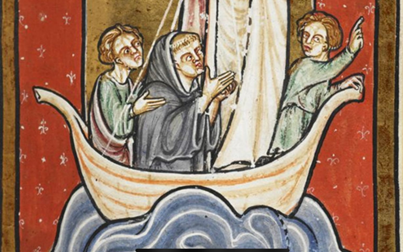
Geri began by saying that Tavistock is known for its abbey and pannier market but not its maritime connections which are surprisingly strong. This is peculiar in that it is a landlocked town and the River Tavy is not navigable past Lopwell, 7 miles away.
It was the monks at the Abbey that started the maritime connection and set up the port of Morwellham in the 10th century. They owned a large area of the countryside down to the south coast and they drew income from farming, mining, fishing, trade and harbour dues. In 1114 King Henry I gave them land on the Isles of Scilly. They built a priory on Tresco, charged anchor fees for 1000 ships and had wrecking rights. However, this enterprise proved too much to cope with and they backed out of the seafaring business.
The discovery of a wall painting of a ship on the first floor of a shop on Market Street has revealed traces of Tavistock’s hidden maritime past. Only half survives but it is very well preserved showing the warship’s bow, forecastle, mast and fighting top and the colours and design bear a close resemblance to the Mary Rose which sank in the Solent in 1545. Geri consulted a number of experts to give opinions on the design of the ship, the painting itself and the building. One expert said it looked like the ship dated from between 1509 and 1570 and a timber expert was confident that the remnants of the beams were early 16th century as he was able to trace what was left into the next-door building. The art conservator studied the style and analysis of the pigments used and also dated it as around the late 16th century.
Henry VII had started the navy but Henry VIII was the first to make it a permanent force. He also had the option of requisitioning merchant ships to form part of the navy should the need arise. Tavistock’s link to the King’s navy was John Russell, 1st Earl of Bedford who served as Lord High Admiral 1540 to 1542, at the same time as being gifted the Abbey lands after the Dissolution. Amongst his many responsibilities was the maintaining of coastal defences in the West and later conscripting sailors and ship owners to arm their vessels in readiness against attacks from the French and Spanish. He also had a share in a ship, the Mawdelyn Russell so could this be the ship depicted in the painting? There were other men: William Hawkins who sailed the Paul of Plymouth and had trading activities to Africa and Brazil and William’s son, John, who took the Jesus of Lubeck to West Africa and Venezuela with his cousin, Francis Drake. These could also be the ship in the painting and there are other possibilities too: Nicholas Glanfield’s the William and John, which may have been involved with arms dealing with the Hawkins brothers. Was the owner of the building a prominent person in naval circles?
Geri’s fascinating talk illustrated that Tavistock was clearly involved in maritime trading, privateering and arms dealing during the Tudor period, and further research into the painting and its ownership may reveal more of its hidden heritage.
A Pair of Shoes for a Poor Child – a talk by Dr. Sue Andrews
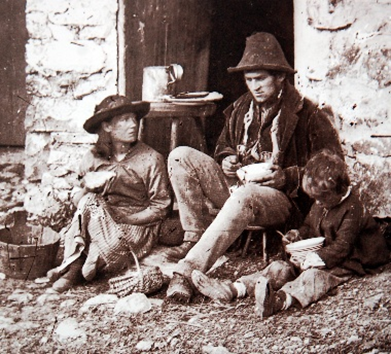
Sue’s talk focused on the fortunes of three members of the Payne family from the late C18 to the early C20, a period of huge change. Elizabeth, born c1762 and baptised at Dunterton lived through a time when many country people were illiterate and poor, barely able to afford a pair of shoes. Written records are scarce but changes were happening in the countryside; people were migrating to the towns as jobs were lost due to mechanisation and improved methods of production replacing manual labour.
During a period of 27 years from the age of eighteen, Elizabeth had 8 illegitimate sons, with records revealing that in one case at least she was “examined” in an attempt to discover the father. Records of her poverty can be found in the Lamerton Overseers of the Poor Account Book with details of her receiving monies to purchase shoes, clothes and blankets in times of harsh conditions. These payments continued until 1836. Further records show her in the Lamerton Poorhouse aged 80 and later dying aged 85 – a remarkable age considering her lifestyle. She was buried in an unmarked grave in Lamerton Parish churchyard.
Robert, her youngest son, is recorded in 1814 as being an apprentice (aged 7) to a yeoman. His duties probably included bird scaring, stone picking, looking after sheep and harvesting – hard labour and long hours. He married in 1833 to Maria Youlden (also illiterate), a widow with one daughter, and had six more children at Eastacott Farm, Dunterton, two of whom died of Scarlatina, aged 5 and 3 in 1842. Robert and his family then moved to Bradstone, working as an agricultural labourer at Bradstone Barton and living in Sandys Cottage,. Two more children were born in Bradstone.
Around 1840 the Parish of Bradstone comprised eight farmhouses and small cottages and there was a lot of activity around the production of cider, crops, and husbandry. Living conditions, however, were still harsh for many agricultural labourers and, in 1860, Canon Girdlestone, Vicar of Halberton, near Tiverton, raised concerns and was a prime mover in initiating changes, some of which involved relocating families to locations in the north of England where prospects were better. Robert died in 1881, aged 75, at Sandys Cottage and was buried in an unmarked grave in Bradstone churchyard. His wife Marie relocated to Devonport, but when she died 3 years later she was brought back to Bradstone for burial.
James Payne, Robert’s youngest son, was born in 1853 and started life with jobs in agricultural labouring and mining. However, through improved education he was literate, intelligent and ambitious, moving away to a more urban environment. Through good references he joined the police and progressed at the age of 45 to 1st Class Merit Constable, having lived first in Torquay and then Alphington. He and his wife Annie had seven children and eventually moved to Plymstock. He was highly thought of but retired in 1901, dying of cancer two years later at the age of 50. He is buried in Plymstock Church with a fine gravestone.
Sue’s excellent talk was not only a family history (James was her great grandfather) but an account of the social history of those times and how despite the poverty and hardships, some people were able to get through and survive to surprising longevity. Some also overcoming their hard starts to life to pursue successful careers.
Berra Tor Farm: a History = a talk by David Dance
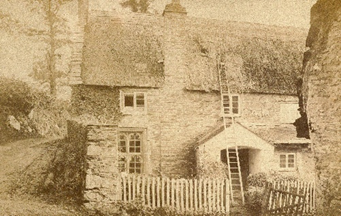
David moved into this Grade 2* listed farmhouse in 1994, retired from his full-time job in 2019 and like perhaps many people found time and interest during the Covid period to do some history research and write a book. He has since uncovered around 200 years of the farmhouse’s history with more to be revealed perhaps. Much of the information has come from censuses, conveyances and C19 tithe maps,
These show an original farm in a field nearby (no trace today) with the name of Cudgeford with research complicated by a further 14 variants of its spelling and the switching of the name to Berra Tor (finally consolidated in 1901 as the current name).
It sits on what was probably a major route towards the Tavy at Hatch Mill. It is thought that in the C15 it was a short longhouse with shippon. The famous antiquary GW Copeland who visited the farm in 1951 noted other interesting features – a once wider entrance for animals, oak studded door with fleur-de-lys hinges, granite door frames, huge rough cross beams, curving stone fireplace and a mullioned window. The latter item proved to be of significant interest, theories ranging from a relic of a nearby medieval chapel (shown on old maps) to salvage from Buckland Abbey (maybe after the Dissolution). An old photo from 1880 (see above) shows a thatched roof and two chimneys – now gone.
David then traced the ownership and occupiers from the early C18, the Buckland Abbey estate featuring then, along with the Crymes family – Richard having purchased the manor of Buckland Monachorum including Berra Tor. This then moved on to the Duke of Bedford (DOB) and by the mid C18 the Corters. It passed then through several generations of this family with Samuel Jnr also leasing other land from Lopez and employing large teams of helpers. When he died in 1871 it was bought again by the Bedford estate (along with 1,000 apple trees), its state of repair described as “bad”.
Around this time too there is a mysterious reference to 3 fulling mills in the area including one at Cudgeford – further research required here. Bidgoods were tenants through the agricultural depression period up to 1886, then the Veales through the 1891 time of huge floods in the parish and . subsequently after the first big DOB sale in 1901. Frank Rowe reportedly ran a successful farm from 1921 though it was sold again in 1950 (with hunting and fishing rights) after he became ill. Further occupiers included Tuckett, Henry Towl and in 1973 Tom Malcolm.
At this point, the farm became a home with extensive alterations being carried by the new owners. By 1988 the Gullifords were there, eventually moving into the cottage next door to make way for David and his wife in 1994.
Perhaps David could be persuaded to continue his fascinating research into the first 300 years and come back in the future for part 2.
Tyrwhitt’s Tramway: the Plymouth & Dartmoor Railway – a talk by Simon Dell
Sir Thomas (1762-1833) initially served as the private secretary to the Prince of Wales (later King George IV) and founded the settlement of “Prince’s Town”. Following the closure of his first project, Dartmoor Prison in 1815, he turned his endeavours to other ideas for bringing prosperity to the town and area.
At this time, the Plymouth breakwater was under construction and granite from King’s Tor quarry, owned by the Johnson brothers was in great demand, being shipped by horse, cart, and canal.. Also peat, flux and ores were going off the moor with sea sand, timber and coal coming in, again by slow and costly transport. Sir Thomas thus conceived the idea of a railway which he thought would bring significant benefits – both to the area and “interested parties.”
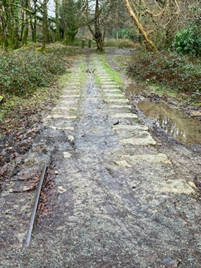
Following an Act of Parliament in 1819, the railway was launched to over 1,000 people at a grand breakfast ceremony. A single track of 4ft 6in gauge, comprised of granite sleepers, cast iron rails and horse drawn, it was opened in 1823. There were various local subscribers involved in the setting up of the Plymouth & Dartmoor Railway Company (P&DRC), including landowners and those with certain interests – Lopez, Maristow, Elford and Lockyer amongst the names, along with the Johnsons at King’s Tor quarry, Wm. Shillabeer was appointed as surveyor and Wm Stuart (the breakwater engineer) as chief engineer.
Initially the route was planned to ascend on steep gradients , difficult for horses, but thanks to Stuart, an alternative route was decided upon , more circuitous but with less climb, from Crabtree Wharf on the Plym to King’s Tor quarry. Despite his initiative it seems Stuart fell out of favour. The Wharf was often stranded at low water so an extension was then built to Cattewater and a new route opened via Saltram (Earl Morley’s land) and a branch to Cann Quarry. Finances were often under strain with many loans and changes of partners and ownership.
By 1826 the company had run out of money and it was the Johnsons who came to the rescue taking on the mortgage and forming the New P&DRC, Tyrwhitt died in 1833. There was considerable traffic on the line, especially in granite though Tyrwhitt’s original idea of opening up the moor to agriculture and development were not fulfilled. However, GWR saw opportunities in steam and the demand for passenger transport, taking over the top section in 1877 and the rest by 1883 – the original tramway finally closing. The GWR line closed in 1956.
Through his innovative use of AI and unique humour Simon illustrated his talk with images of various sections en-route, many of which can be seen today, including the Leigham tunnel (2nd of its kind in the world), the Crabtree weighbridge, granite sleepers and mileposts, halts and sidings, and the stable block above Clearbrook.